
Cut Breach Compromise Rate by 90%: How to Score All Staff’s Security Awareness with Combat-Oriented Practical Data
I. Enterprise Information Security Risk Analysis
In the field of information security, there is a paradox that has almost become an industry consensus:
Companies invest millions in technology stacks like firewalls, EDR, and SIEM, but what ultimately brings down the entire security defense system is often just a malicious link casually clicked by a tired employee on a Friday afternoon.
Scenario Replay:
At the end of a quarter, an email disguised as a "Quarterly Performance Adjustment Notice" quietly enters the corporate mailbox. The sender's address is extremely similar to that of the company's HR department, and even the format of the internal network signature matches perfectly. Five minutes later, a manager of a key business department clicks the link on their phone and enters their domain account and password into a highly counterfeited digital office system.
What follows is silent privilege theft, exfiltration of core data assets, and a chain security crisis in the supply chain triggered by stolen credentials.
As an enterprise information security leader, you may be facing such challenges: security training sessions are held one after another, PPTs are presented over and over, but the effectiveness of traditional paper-based training is like a black box, impossible to quantify and verify. Employees' security awareness varies greatly, and when facing highly customized social engineering phishing and fake office messages, they still struggle to distinguish real from fake.
Security is not just about technical offense and defense, but also a game of human nature. When traditional static "passive protection" can no longer cope with highly dynamic new threats, enterprises urgently need a normalized, practical testing method to precisely identify the weak links of all employees.

II. Value Proposition
To address the above security pain points, UPC, based on years of accumulated offensive and defensive combat experience, has launched the [Practical Phishing Exercise Service]. We advocate transforming "security training" into "proactive testing and defense," and by building a full-link, measurable defense closed-loop, we assist CIOs and CISOs in reshaping the enterprise's human security firewall.
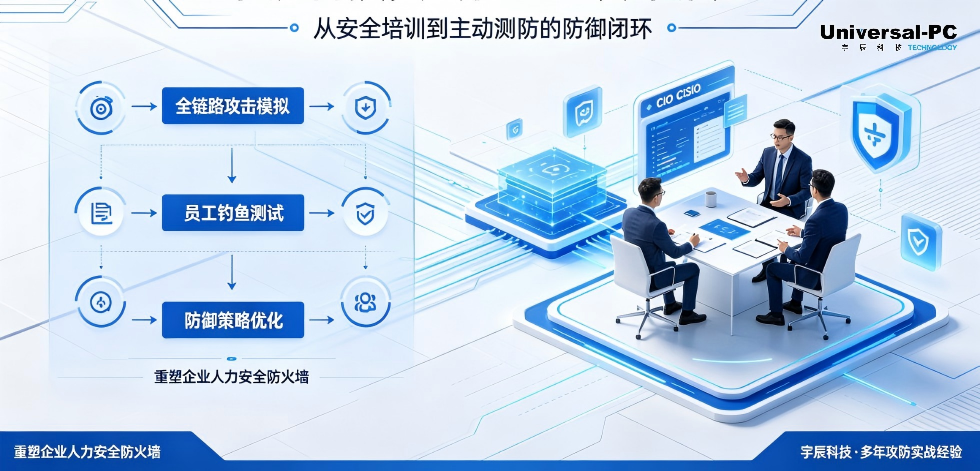
Dimension 1: From "Blind Training" to "Precise Measurement"
── Reshaping the Digital Baseline of Employee Security Awareness
Potential Issues: Enterprises cannot accurately assess the real security level of employees in different departments and at different levels. Security leaders lack a digital "security weakness map," causing security budgets and training resources to be evenly distributed, making it difficult to be targeted.
Root Cause Analysis: Traditional lecture-style training belongs to the "knowledge" level, while employees' performance when facing phishing attacks belongs to the "action" level. The "disconnect between knowledge and action" and the lack of a digital baseline are the fundamental reasons why security defenses become mere formalities.
UPC Solution:
UPC provides a full-process data-visualized review service. After the exercise starts, the system will automatically track and record key data throughout the exercise cycle (such as email open rate, link click rate, credential input rate, proactive reporting rate, etc.).
Through multi-dimensional, multi-perspective quantitative dashboards, security leaders can precisely locate the security weaknesses of all employees, down to specific departments, positions, and even individuals. This not only transforms unmeasurable security awareness into clear digital KPIs, but also provides intuitive data backing for your reports to management on the return on investment (ROI) of security.
Dimension 2: From "Template Application" to "Deep Simulation"
── Reproducing Real Advanced Social Engineering Attacks
Potential Issues: Many ordinary phishing exercise tools on the market have single templates and outdated patterns. Employees can see through them at a glance, and exercises often become a perfunctory "guessing game" that fails to serve as a real warning and test.
Root Cause Analysis: Real hacker attacks are highly customized and closely follow current events or internal enterprise business scenarios. Low-fidelity exercises cannot simulate the intensity of real attack and defense confrontations, and once facing Advanced Persistent Threats (APT), the defense line will collapse instantly.
UPC Solution:
UPC has a professional threat intelligence library, supporting customized scenario on-demand exercises. We can deeply reshape full-link simulated phishing attack scenarios, including highly counterfeited official websites, social engineering phishing emails, malicious links, and fake office messages, tailored to the industry characteristics, business processes, and specific position workflows (such as finance, HR, supply chain, etc.) of the enterprise.
This high-fidelity practical simulation allows employees to be tested in their unguarded daily work, effectively improving their muscle memory and recognition ability against new and complex social engineering attacks, and nipping potential financial and data loss risks in the bud before they actually occur.
Dimension 3: From "Just Distribution" to "Full-Dimensional Closed-Loop"
── Providing One-Stop Strategic-Level Remediation Guidance
Potential Issues: Many enterprises, after organizing exercises themselves or purchasing third-party software for exercises, often face the awkward situation of "the exercise ends, the project ends." For high-risk employees identified in the tests, there is a lack of effective and humanized follow-up and remediation measures.
Root Cause Analysis: The core purpose of phishing exercises is not to "catch current violations" or punish employees, but to identify gaps and improve the overall security resilience of the organization. Exercises without a closed-loop cannot fundamentally reverse employees' dangerous behavioral habits.
UPC Solution:
Unlike single tool providers, UPC provides a one-stop full-cycle service covering exercise planning, distribution, statistics, and remediation guidance. After the exercise, we not only output in-depth professional review reports, but also provide personalized micro-course push, triggered just-in-time education, and long-term security culture building plans.
Through this full-cycle consulting service, we assist enterprises in transforming from passive protection to proactive testing and defense, establishing a spiraling upward mechanism of "exercise-discovery-education-improvement-re-exercise," truly transforming information security into a core asset of the enterprise rather than a cost burden.
III. Authoritative Practical Case Endorsement
In a recent customized phishing exercise implemented by UPC for a large manufacturing enterprise, we conducted deep scenario simulation for its supply chain management and financial processes.
The results of the first exercise exceeded everyone's expectations: without any warning, the overall link click rate of key departments reached as high as 35%, and several core position personnel even submitted intranet credentials on counterfeited pages.
Relying on UPC's full-process closed-loop remediation service, we conducted targeted, engaging visual education and a second practical spot test for high-risk groups. After three consecutive quarters of normalized practical exercises, the enterprise's overall compromise rate was successfully reduced to below 2%, and the proactive security reporting rate of all employees significantly improved.
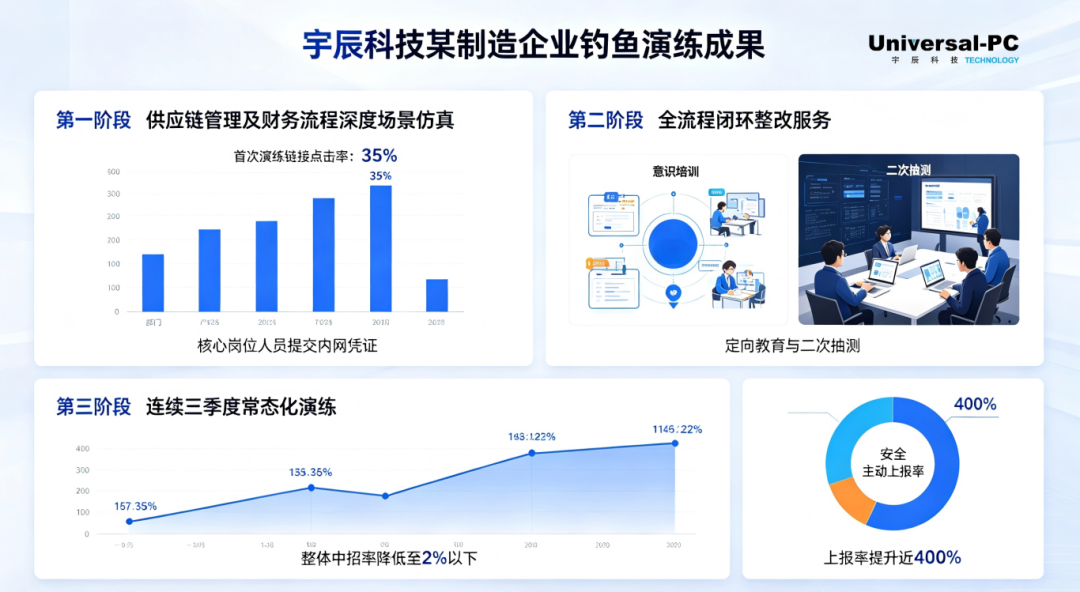
This achievement not only passed the almost stringent compliance verification within the group, but also allowed the enterprise's security leader to successfully demonstrate the excellent results of information security governance at the group's annual strategy meeting.
Information security is an endless protracted war, and the most difficult to secure, yet most worthy of investment, is the "human" link in the organization. UPC Phishing Exercise Service is not just a detection tool, but a proactive security strategic solution that empowers all enterprise employees and transforms human vulnerabilities into digital defense lines.
Full-link practical exercises make hidden risks visible and security measurable.
