
Weak Security Awareness as the Biggest Vulnerability: How to Remediate the Fragile Human Factor Flaw in Enterprise Security Defenses
I. Pain Points Direct Hit
Today, as digital transformation enters deeper waters, enterprises spare no expense to build rigorous cybersecurity defenses: next-generation firewalls, full-traffic detection, zero-trust architecture, advanced endpoint protection (EDR)... The technical barriers are undeniably robust.
However, a reality that causes immense anxiety for countless enterprise information security leaders is: No matter how perfect the defense matrix, it often crumbles due to a single daily habit of an employee.
Scenario 1: A phishing email disguised as a "year-end bonus inquiry" or "system upgrade notice" leads an employee to casually click the link, and ransomware instantly spreads across the internal network.
Scenario 2: For convenience, a developer casually uploads code containing sensitive keys to a public code hosting platform, exposing core assets to widespread leakage risk.
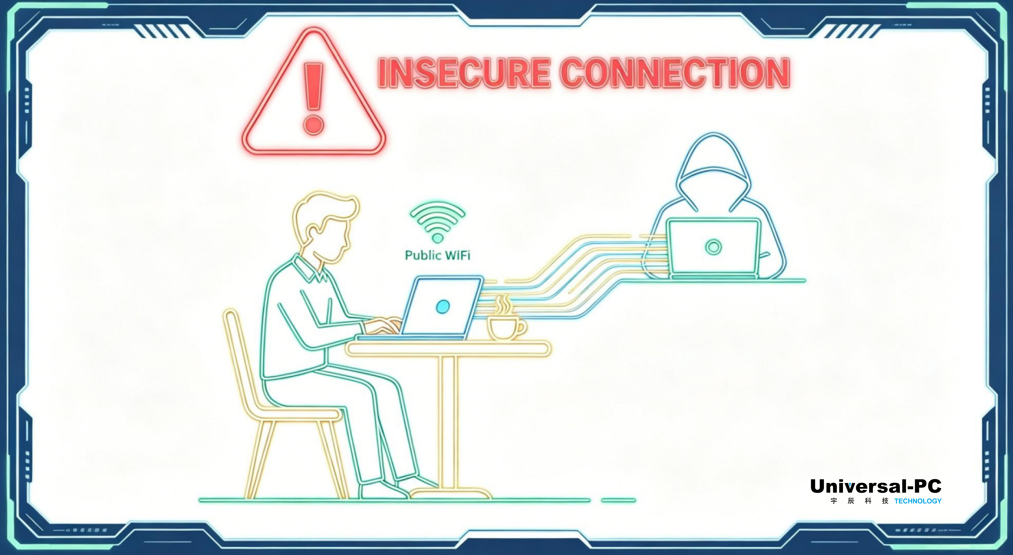
Scenario 3: Business personnel with weak security awareness connect to unknown Wi-Fi in public places, leading to the theft of executive account credentials and putting corporate trade secrets in imminent danger.
These are not alarmist fictional cases, but "black swan" events that truly occur within enterprises every day. Research data shows that over 85% of global cybersecurity data breaches have the shadow of "human factors" behind them.
When "people" become the weakest link in the enterprise security defense line, simply stacking technology can no longer solve the fundamental problem. As the helmsman of enterprise security, how will you break the deadlock?
II. An Upgraded Solution from Risk to Governance
To fundamentally address "human-factor risk," enterprises need a systematic engineering approach that transforms security awareness into employees' daily code of conduct. Based on years of frontline cyber attack-and-defense and security consulting experience, UPC launches the "Enterprise Security Awareness Training Service", aimed at helping enterprises build a dynamic firewall composed of "people."

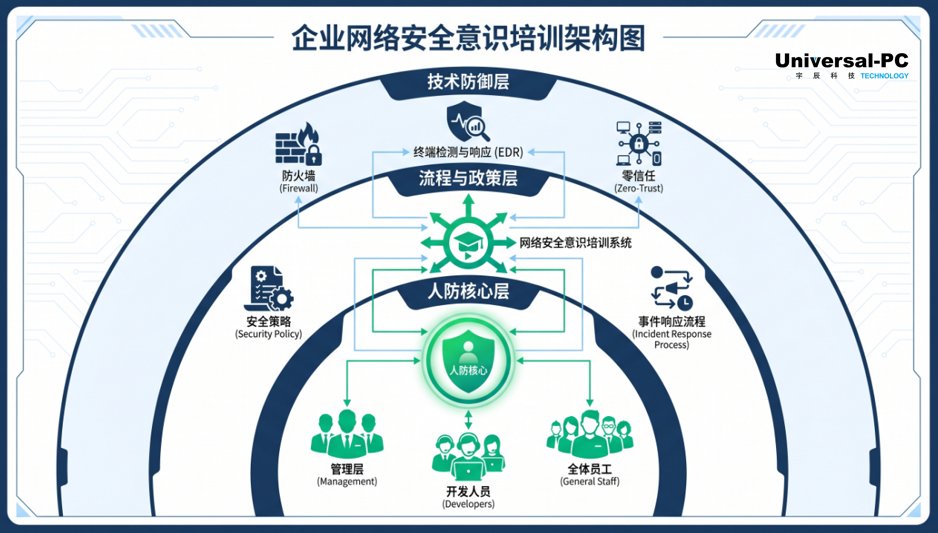
1. Say Goodbye to "One-Size-Fits-All" Lectures: Customized Tiered Teaching Based on Organizational Structure
Most enterprises' security training is ineffective because "cookie-cutter" content cannot match the real risks faced by different positions. Finance personnel don't need to understand encryption algorithms, while developers find generic password-changing rules tedious.
UPC's Breakthrough: We reject template-driven courseware output. Before service launch, UPC's expert team conducts a deep risk baseline assessment for the enterprise.
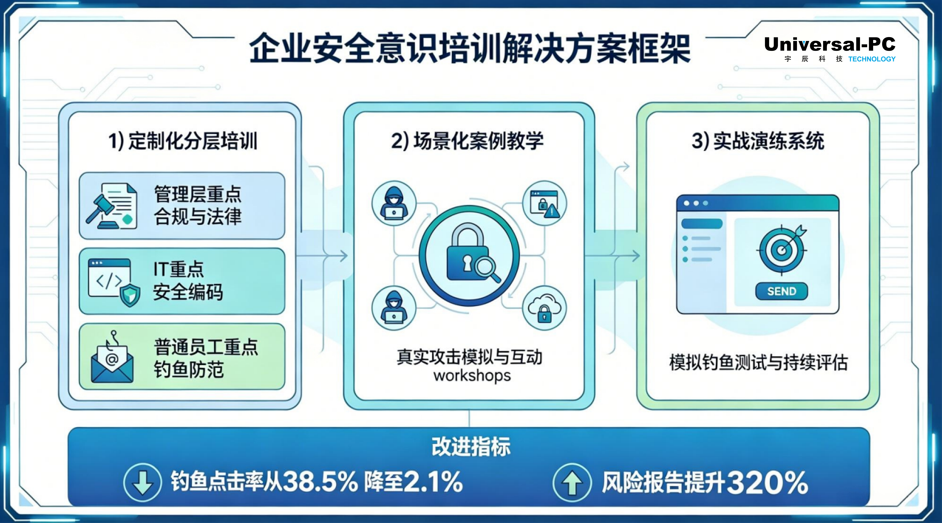
For management, the focus is on strategic perspectives of security compliance, legal risks (such as the "Data Security Law"), and corporate reputation loss.
For R&D and IT personnel, the focus is on secure coding standards, open-source component vulnerability management, and DevSecOps practices.
For front desk, administrative, and financial positions, the focus is on social engineering prevention, anti-phishing exercises, and desktop security.
Your Positive Returns: Through customized tiered teaching, enterprises can, at the lowest time cost, enable every position's employees to precisely acquire security skills that 100% match their work scenarios, transforming training investment into visible risk defense capability.
2. Say Goodbye to "Armchair" Theory: Real-World Scenario Case Teaching and Practical Exercises
Traditional lecture formats often become mere formalities, with employees "excited during the session, forgetting everything afterward." The establishment of security awareness is essentially a change in behavioral habits, which must rely on "muscle memory."
UPC's Breakthrough: We move the "classroom" to the "battlefield." UPC introduces "real-world scenario case teaching", scenario-based replaying of classic real security incidents that have occurred in the industry.
Dual-Track Teaching: Not only are there vivid case analyses, but also imperceptible phishing email practical exercises. Without affecting business operations, real hacker attack methods are simulated to conduct surprise tests on employees.
Your Positive Returns: Through the closed-loop mechanism of "exercise-review-retest," employees can directly experience the serious consequences of "a moment of negligence." This real-world scenario teaching can effectively stimulate employee vigilance, achieving a mindset transformation from "requiring me to be secure" to "wanting to be secure."
III. UPC Observations · Successful Practices
In the complex digital era, security is no longer just an ancillary technology of the IT department, but a core strategic asset of the enterprise. And among all security elements, people are both the greatest source of risk and the strongest firewall.
A leading global fintech group, with over 3,000 employees. Historically, due to non-standard daily employee operations, the group triggered multiple high-risk security alerts per month on average caused by clicking phishing links or unauthorized data exfiltration, leaving the security team overwhelmed.
After UPC intervened, we customized a phased "Security Awareness Reshaping Program" for them. Through tiered customized courses and multiple rounds of progressive simulated phishing exercises:
The employee phishing email compromise rate dropped from the initial 38.5% to 2.1%;
The proportion of employees proactively reporting unknown security risks increased by 320%.
This not only helped the enterprise avoid potential data breach crises, but also reduced the passive response costs of the security team by nearly 60%.
With deep industry accumulation, UPC has successfully provided in-depth security awareness training services for leading enterprises in finance, manufacturing, technology, and other fields. We deeply understand the compliance red lines and business pain points of different industries, and can provide customized solutions that combine industry-level vision with practical effectiveness.
Filling the last gap in security should not wait until after a security incident occurs.
