
Massive Privilege Escalation Vulnerability Copy Fail (CVE-2026-31431) Exploited! Exploitable for Linux Kernels Released in the Past 9 Years – Are Your Servers Secure?
Foreword
Another heavy bomb has been dropped in the security circle!
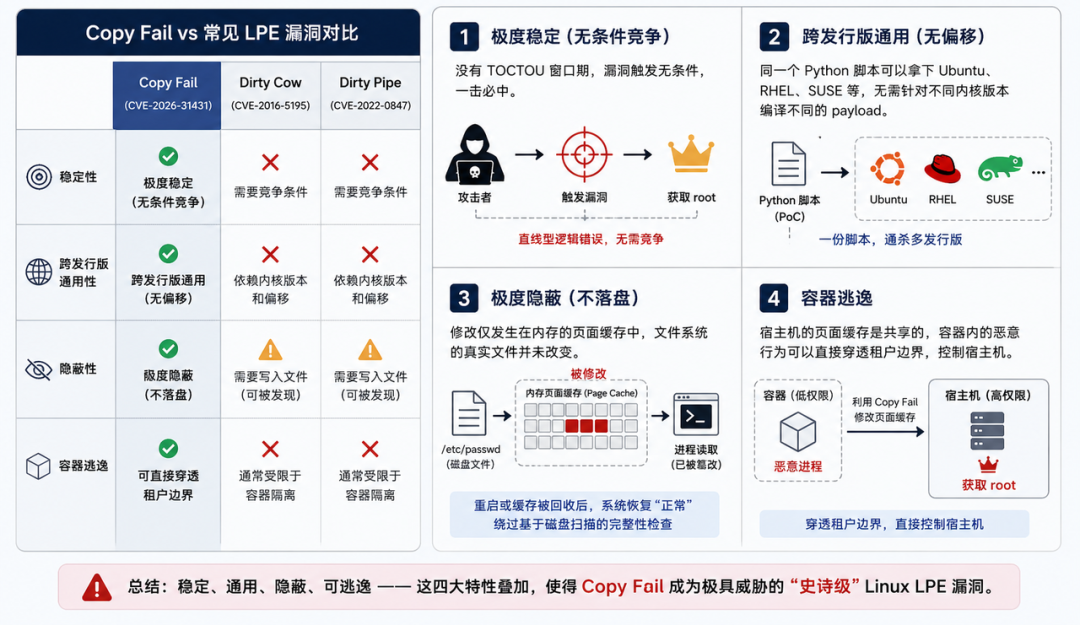
Today, a Linux kernel vulnerability named "Copy Fail" (CVE-2026-31431) was officially publicly disclosed. This vulnerability can use a mere 732-byte Python script to achieve 100% reliable Local Privilege Escalation (LPE) on almost all Linux distributions released since 2017, directly obtaining root privileges. Even more critically, it is also a perfect container escape primitive, because it directly modifies the host-shared page cache. This is not an ordinary race condition vulnerability, nor does it require any kernel-specific offsets. The same script can universally compromise mainstream distributions such as Ubuntu, Amazon Linux, RHEL, and SUSE, making it truly "epic."
As blue team defenders who have long been fighting risks on the frontline, facing this nuclear-grade vulnerability, we must quickly clarify its disaster-causing principles and implement defense rules immediately.
1. What is Copy Fail (CVE-2026-31431)?
Simply put, this is a logical flaw located in the Linux kernel cryptographic API (AF_ALG).
Impact Scope: Kernels built between 2017 and 2026 (covering almost all mainstream distributions such as Ubuntu, RHEL, Amazon Linux, etc.).
Exploitation Conditions: Only requires a non-privileged local user account. No network access needed, no debugging features required.
Massive Power: An attacker can write 4 controlled bytes into the page cache of any readable file through a pure Python script of only 732 bytes. By modifying the memory cache of setuid programs like
/usr/bin/su, attackers can directly obtain root privileges.Disclosure Level: EXP has been publicly released, 732 bytes, 100% stable reproduction.
2. Why is it called "Epic"?
Compared to common Linux LPE vulnerabilities (such as Dirty Cow or Dirty Pipe), Copy Fail has lethal characteristics:

 3. Defense Recommendations
3.1 Emergency Measures
Disable related modules (if no business dependency)
modprobe -r algif_aeadIf your environment hits any of the following special configurations, disabling algif_aead may cause service startup failures or cryptographic downgrades: (1) OpenSSL configured with hardware cryptographic acceleration offloading; (2) Using specific kernel cryptographic toolsets; (3) Certain specific Java or Python cryptography library configurations; (4) Some Internet of Things (IoT) or edge computing devices.
You can use
lsmod | grep algif_aeadcommand to quickly confirm whether any process on the current server is using this interface.
Upgrade kernel patches (prioritize core assets)
Reboot system after remediation (clean page cache)
3.2 Detection Key Points
Core logic:
Anomalous call chain: AF_ALG + splice
Recommended minimum actions:
Monitor
socket(AF_ALG)Monitor
spliceIdentify unconventional process triggers
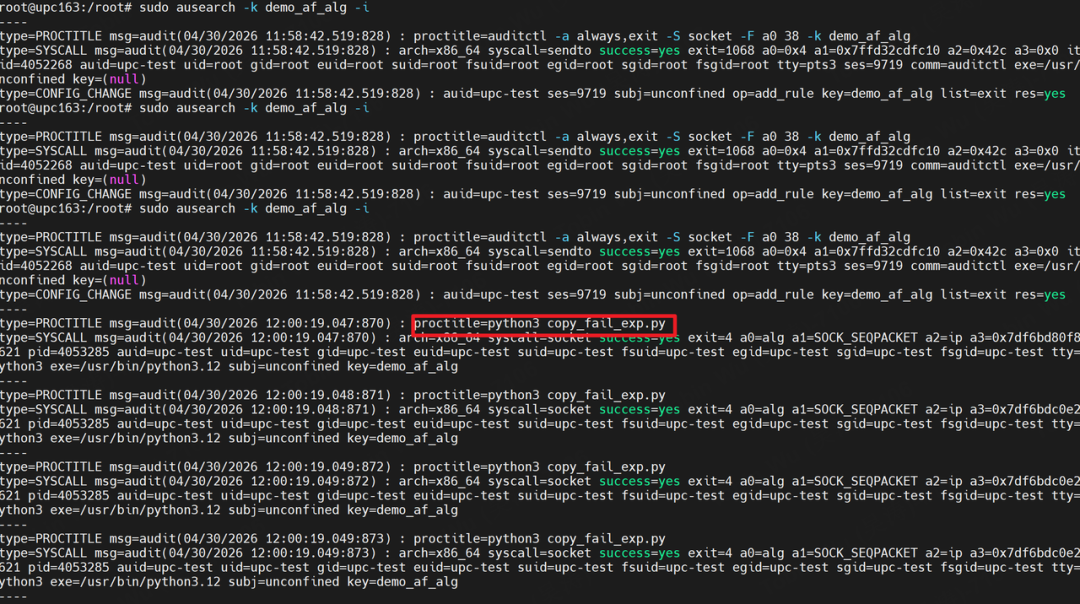
Simple auditd rule example:
-a always,exit -S socket -F a0=38 -k af_algSample alert as follows:

 3.3 Hardening Recommendations (Medium-Long Term)
Reduce attack surface: Disable unnecessary kernel capabilities
Container restrictions: Use seccomp to restrict syscalls
Host-side detection: Introduce EDR / eBPF behavior monitoring
3.4 Environment Investigation
CVE-2026-31431 must be included as a key investigation item:
Inventory Linux hosts with kernel versions between 2017-2026 in assets.
Check whether disable rules for
algif_aeadhave been configured under/etc/modprobe.d/.Check whether Seccomp interception for
AF_ALGis enabled in container clusters.
4. Summary
Copy Fail reminds us once again that even underlying infrastructure code that has been running for a decade may harbor shocking landmines. As defenders, we cannot rely solely on vendor patches; we need to build defense-in-depth systems (such as Seccomp, runtime behavior analysis) and take effective mitigation measures at the first opportunity to gain the initiative in the attack-defense game.
